A young Lee O’Shaughnessy sat in his Catholic primary school as his teacher talked about the resurrection of Jesus. His hand shot up.
“Oh, so Jesus is a zombie,” he said and ended up in lunch detention for his outburst.
Now, Lee is 15 years old attending Merlin College, a multi-faith school in Galway. He is still skeptical of religion, identifying as an atheist in a predominantly Catholic community within a country where nationality and religiosity have gone hand in hand throughout its history.
For him, his decision to identify as an atheist comes from a combination of his non-religious upbringing, the church’s involvement in politics, and the fact that Christianity has never really made sense to him.
“I don’t like the idea of church and an old book telling me what to do,” Lee said.
Lee grew up with non-religious parents in the Doughiska community and even his parents grew up in a non-religious household as well which Lee deemed “unusual for this area.”
Despite his upbringing and beliefs, he still went through the Catholic baptism, communion and confirmation.
He went through it because it is just a part of growing up, and it is a way to bring family together. Lee said it is typical for his friends who are not religious to still partake in the sacraments.
“A lot of the people I know who have been confirmed will tell you that they did it because they get a lot of money from family,” Lee laughed.
Kaylagh Keenan is one of his friends and classmates who has also been baptized and confirmed and does not consider herself religious. However, she still stands firm in her belief in God.
“I believe in God. One hundred and ten percent I do. But I’m just not holy,” Kaylagh said.
For her, it is more about having faith and making sense of her existence rather than going to mass every Sunday.
Kaylagh has also noticed a change in the way Galway operates as more and more people start to move away from religion. More local stores open early and stay open on Sundays which has not always been the case.
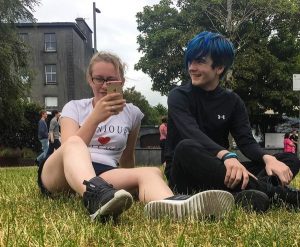
“Sunday’s now the busy day. It’s not for mass. It’s not the holy day,” she said.
According to the 2016 Irish Census, Galway City, where Lee and Kaylagh have grown up, is one of the least religious cities in the country where 16.8 percent claim to have no religion.
In the education realm, Ireland has seen an increase in multi-faith schools like Merlin College, especially at the post-primary level. The primary schools are the ones that still remain heavily Catholic in Ireland.
“In primary school, we were taught Christianity as the only religion, but I never really took to that,” Lee said.
In their current school, Lee and Kaylagh have both taken religion as a class that works to encompass different faiths and their teachings into the curriculum. Their favorite part of the class was taking a visit to a local mosque. Classes like this are being put into place to open minds and create conversations especially as Ireland and particularly Galway becomes more diverse.
“Over the last couple of years, they have built churches for other religions, you know, like mosques and synagogues,” Lee explained.
Not only are they learning about different faiths and backgrounds at school, but they are also members of Foróige, a youth organization created to give young people a space to explore themselves and socialize with people who might not be exactly like them. Foróige hosts programs for the youth ranging from outdoor activities to discussions about sexuality and diversity. Because the organization is not religiously affiliated, the conclusions about what they believe and how they should feel are made by the youth themselves.
“For me, it is about freedom,” Kaylagh said. “I don’t want to contradict myself or say the wrong thing, so I just go with the flow.”
Even though Lee is not of age to vote yet, that does not stop him from examining the church’s role in politics.
“Why does the church care? Isn’t that the government’s responsibility? It’s just odd to me,” Lee said.
Politically, the Catholic Church still has its grip on Ireland, but it has started to loosen up as the country becomes more progressive in terms of policies on marriage equality and reproductive rights. The Church’s involvement in government is not something unique to Ireland, but it is something that has caused the shift away from it, especially with young people.
Kaylagh and Lee have found their communities outside of the Church made up of different people that have the option and the space to talk about their differences if they choose to do so. For Kaylagh, religion is not something that creates barriers.
“Religion is the last thing that comes up in conversation,” Kaylagh said when talking about her friends.
The Catholic faith is something that has influenced Ireland’s culture, society and history and has long defined what it means to be Irish.
Young people like Lee and Kaylagh still have kept Irish-Catholic traditions alive but with an education system that explores different faiths and a youth group that fosters acceptance they have redefined Irish-ness for themselves and quite possibly future generations.
“I find my sense of community elsewhere,” Lee said.
by Anna Saunders